checklist
What should I check before I accept a client's stone across my bench for a remount?
An intake done badly turns a chipped girdle into your problem. A concrete checklist for receiving, documenting and insuring a stone that belongs to someone else.
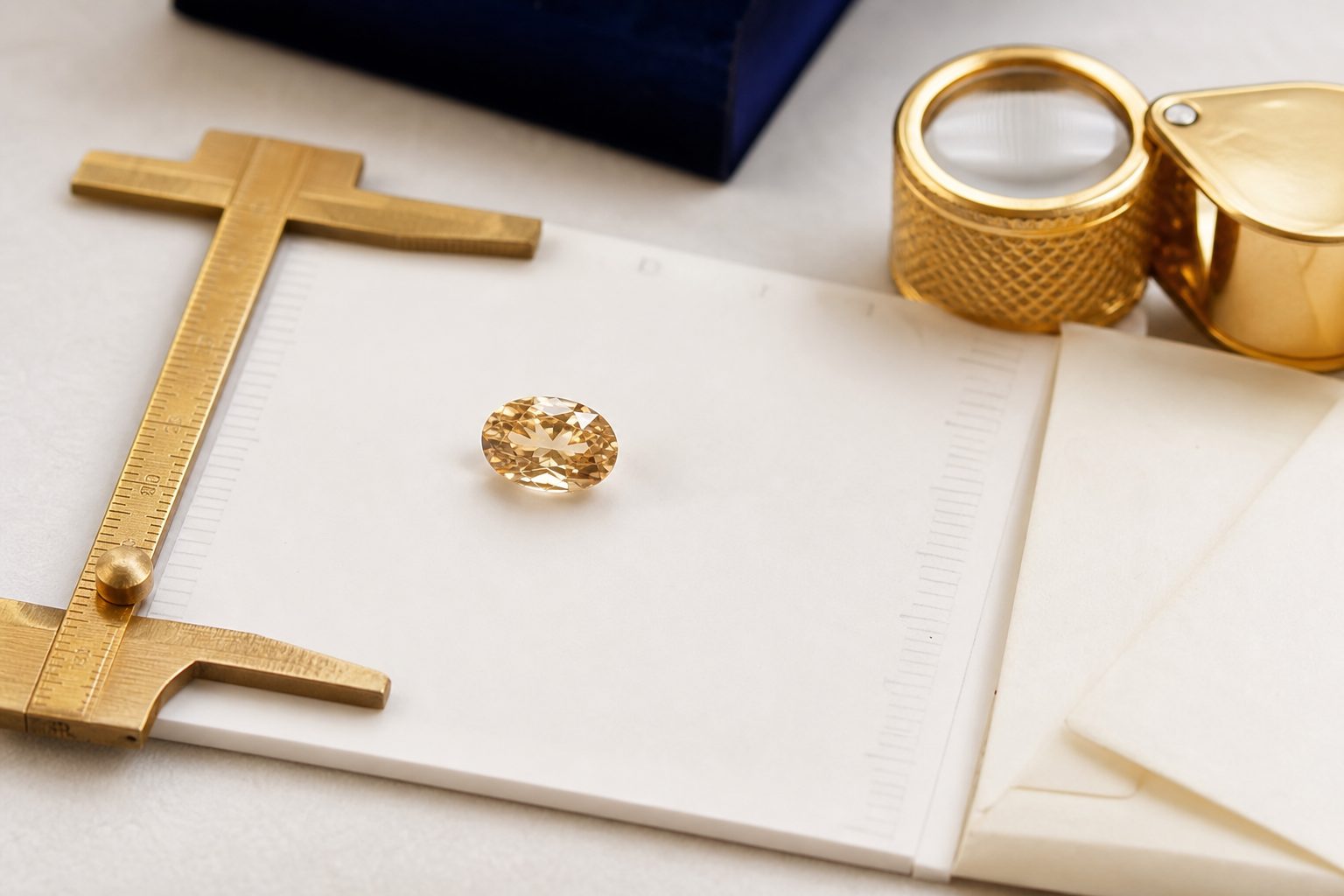
Before you accept a client's stone, you need four things on record: its weight, its measurements, photographs at magnification, and a signed receipt that describes the condition you found it in. Everything else in a remount is negotiable. Those four are not, because they are the only evidence you will have if the client comes back in March and says the girdle was clean when she handed it over in January.
The risk is not that you will damage the stone. Most of the time you will not. The risk is that the damage was already there, invisible under a mounting that had held the same six prongs since 1978, and that nobody looked at it closely until it came out of the head and onto your bench pad. At that moment the chip becomes yours unless you can prove otherwise.
What follows is the intake sequence for a one person studio. It takes about twenty minutes per stone, it happens with the client sitting across from you, and it is the cheapest insurance you will ever buy.
Weighing, measuring and photographing before anything else
If the stone is still in its mounting, you cannot weigh it directly. Say so out loud and write down the estimated weight from the appraisal or the report, marked as estimated. Then measure the visible dimensions with a leveridge gauge or calipers: diameter and depth on a round, length by width by depth on a fancy shape. Record to the hundredth of a millimeter.
If the stone is loose, put it on the carat scale in front of the client. Read the number aloud, write it on the intake form, and have her look at the display. A stone that weighs 1.42 carats going in must weigh 1.42 carats coming out, and if it does not, that is a conversation you want to have with a witnessed starting number.
The photographs that actually matter
Take a table up shot, a pavilion shot, and a profile. Then take at least two through a loupe or a scope camera at the areas most likely to be damaged: the girdle, the culet, and any point or corner. Marquise tips, princess corners and pear points chip first. Photograph them specifically, not incidentally.
Date stamp the files or drop them straight into the job record so the timestamp is preserved. A photo with no verifiable date is a photo that proves nothing.
Keep reading: How many billable bench hours can I actually get out of a week running my own studio?
Inspecting under magnification for chips, abrasions and feathers
Work at 10x first, then higher if something catches your eye. You are not grading the stone. You are documenting condition. Three categories matter.
- Chips and nicks. Usually on the girdle where a prong sat, or on a point. Small, bright, and easy to miss against a facet junction.
- Abrasions. Dulled facet edges from decades of wear. Not a defect you caused, but a client who has never looked at her stone under magnification will believe it is.
- Feathers reaching the surface. These are the ones that turn a routine tightening into a broken stone under the heat of a torch or the pressure of a setting burnisher.
If you find a surface reaching feather in a stone you are being asked to reset, that is the moment to raise it, before you quote, not after. Some stones should be set cold, some should go to a setter with more experience in that material, and some genuinely should not be reset at all in the design the client is imagining.
Recording existing damage where the client can see it
Do this part with her at the bench, not later at your desk. Put the stone under the scope, turn the monitor toward her, and point at the chip. Then write it on the intake form while she watches: "girdle chip approximately 0.3mm at 4 o'clock position, present at intake."
Ask her to initial that line. Not sign the whole form, initial that specific line. It changes the character of the record from something you wrote to something she acknowledged.
Clients almost never object. What they object to is being told about damage three weeks later when they have no way to know when it happened.
Grading reports, appraisals and what they do not cover
A grading report from a recognized laboratory describes the stone at the moment it was graded, which may have been twenty years ago. It is a description, not a warranty of present condition, and it does not travel with the stone as proof that nothing has happened since.
A retail replacement appraisal is a different animal again. It exists to set an insurance value, it is usually written high, and it is not evidence of condition at all. Do not accept an appraisal as a substitute for your own intake inspection.
| Document | What it tells you | What it does not |
|---|---|---|
| Lab grading report | Weight, measurements, clarity and color grade at date of grading, plotted inclusions | Present condition, whether this is the same stone in the ring |
| Insurance appraisal | A replacement value figure for a policy | Objective grading, condition, or what you would pay for it |
| Your intake record | Condition on the day it crossed your bench, with photographs | Origin, treatment history, authenticity |
One more thing worth checking: does the plotted diagram on the report match what you see? Inclusion plots are a reasonable way to confirm the stone in front of you is the stone the paper describes. If the plot does not match, stop and ask.
Keep reading: What is it really like to take a rush wedding commission with six weeks until the date?
Written intake receipt and the terms it should carry
Verbal intake is how studios end up in small claims court. The receipt should carry, at minimum:
- Client name, contact information and date received.
- Description of the item, including estimated or measured weight, dimensions, and metal.
- Condition notes, including every defect found, initialed.
- The scope of work agreed, in plain language.
- A stated value for the item while it is in your possession, and who insures it.
- Storage and abandonment terms if the client does not collect.
- Your signature and hers.
Give her a copy before she leaves. A receipt she never received is a receipt that does not exist.
Jewelers block insurance and customer property coverage
A jewelers block policy is the trade's standard property coverage, and the part that matters here is the customer goods section, which covers property belonging to others while it is in your care, custody and control. Read your own declarations page for the customer goods sublimit specifically. It is frequently much lower than your total policy limit.
Then run the arithmetic. If your customer goods limit is $25,000 and you have four remounts on the bench with stated values of $9,000, $6,000, $14,000 and $3,000, you are holding $32,000 against a $25,000 limit. That gap is real money, and it is yours. The fix is either a scheduled increase for the period or staggering the intake dates so you are not holding all four at once.
Also check the out of premises and in transit provisions before you ship anything to a caster or a setter. Coverage while a stone is with a trade shop is not automatic in every policy, and registered mail through the postal service has its own declared value ceiling.
See how BeadInvoice handles this for fine and handmade jewelry commissions
Storage, labeling and chain of custody in a one person studio
One stone, one envelope, one job number, one place. Parcel papers or coin envelopes marked with the job number and the client's last name, stored in the safe, never loose in a bench drawer overnight.
The failure mode in a solo studio is not theft. It is two similar stones, two similar jobs, and a Thursday afternoon. Job numbers on everything, including the envelope, the paper the stone sits on, and the tray it travels in, prevent the one mistake that no insurance policy will fix for you.
Log every hand off. When a stone leaves for a setter, note the date, the carrier, the tracking number and the declared value. When it comes back, note the date and re inspect before it goes back into the safe.
Return conditions if the client cancels mid-project
Decide this before you need it, and put it in the intake terms. A workable rule for most solo studios:
- Cancellation before design approval: return the stone, retain the design fee, refund the balance of the deposit.
- Cancellation after design approval but before casting: return the stone, retain the design fee plus documented sourcing costs and bench hours to date.
- Cancellation after casting: the metal is committed. Retain the deposit, return the stone, and offer the client the option to pay the balance and take the mounting.
- Any cancellation: the client's own stone always goes back. It was never yours.
Write it that way and the awkward call becomes a two minute conversation instead of a negotiation.
Where this leaves you
Intake is the one part of a remount where twenty minutes of care removes almost all of the downstream risk. Weigh it, measure it, photograph it, inspect it, write it down, get it initialed, and put it in a labeled envelope in the safe.
The place this tends to break down is not the inspection, it is the paperwork afterward, when the condition notes live in a notebook and the quote lives in a spreadsheet and the deposit terms live in an email. BeadInvoice keeps them in one record: the stone details and intake condition, the quote built from metal weight, stone cost and bench hours, the deposit you collect before the bench work starts, and the stage approvals as the job moves. When the client asks in March what the stone looked like in January, you open the job, not four different apps.