practical guide
How do I price a custom engagement ring when the gold market moves every single day?
Metal is the one line on your quote that changes hourly. Here is how to build a quote that survives a spot price swing between the deposit and the casting, without eating the loss yourself.

You price the metal as a pass-through with a dated window, not as a fixed line. The quote you hand a client should show labor, stone and finishing as firm numbers, and show metal as a number calculated at a stated spot price on a stated date, valid for a stated number of days. If the client signs and pays the deposit inside that window, you buy or lock the metal immediately and the number holds. If she takes six weeks to decide, you requote the metal line only.
That single structural change moves the risk to where it belongs. Gold is a commodity you resell, not a service you perform. No casting house, no refiner and no findings supplier absorbs a spot move for you, so there is no reason for you to absorb it for a client who has not yet committed.
The rest is arithmetic and language. Below is how to get the weight right, how to build the surcharge, and what to say at the counter when someone asks why last month's number is not this month's number.
Why the spot price is not the price you pay your refiner
Spot is the price of one troy ounce of pure gold in an institutional market. You are not buying a troy ounce of pure gold. You are buying a few pennyweight of alloyed casting grain, cut, packaged and shipped, from a supplier who has to make a margin on handling it.
Every step between spot and your invoice adds cost:
- Karat dilution. 14K yellow is roughly 58.3 percent fine gold by weight. The rest is copper, silver and zinc, which are cheap but not free.
- Fabrication charge. Refiners and grain suppliers add a per pennyweight or per gram fabrication fee for turning bullion into casting grain, sheet or wire. Sheet and wire cost more than grain.
- Shipping. Insured overnight freight on precious metal is not a rounding error on a one ring order.
- Casting house metal markup. If your caster supplies the metal, they mark it up over their own cost, and they base it on their buy price the day they cast, not the day you quoted.
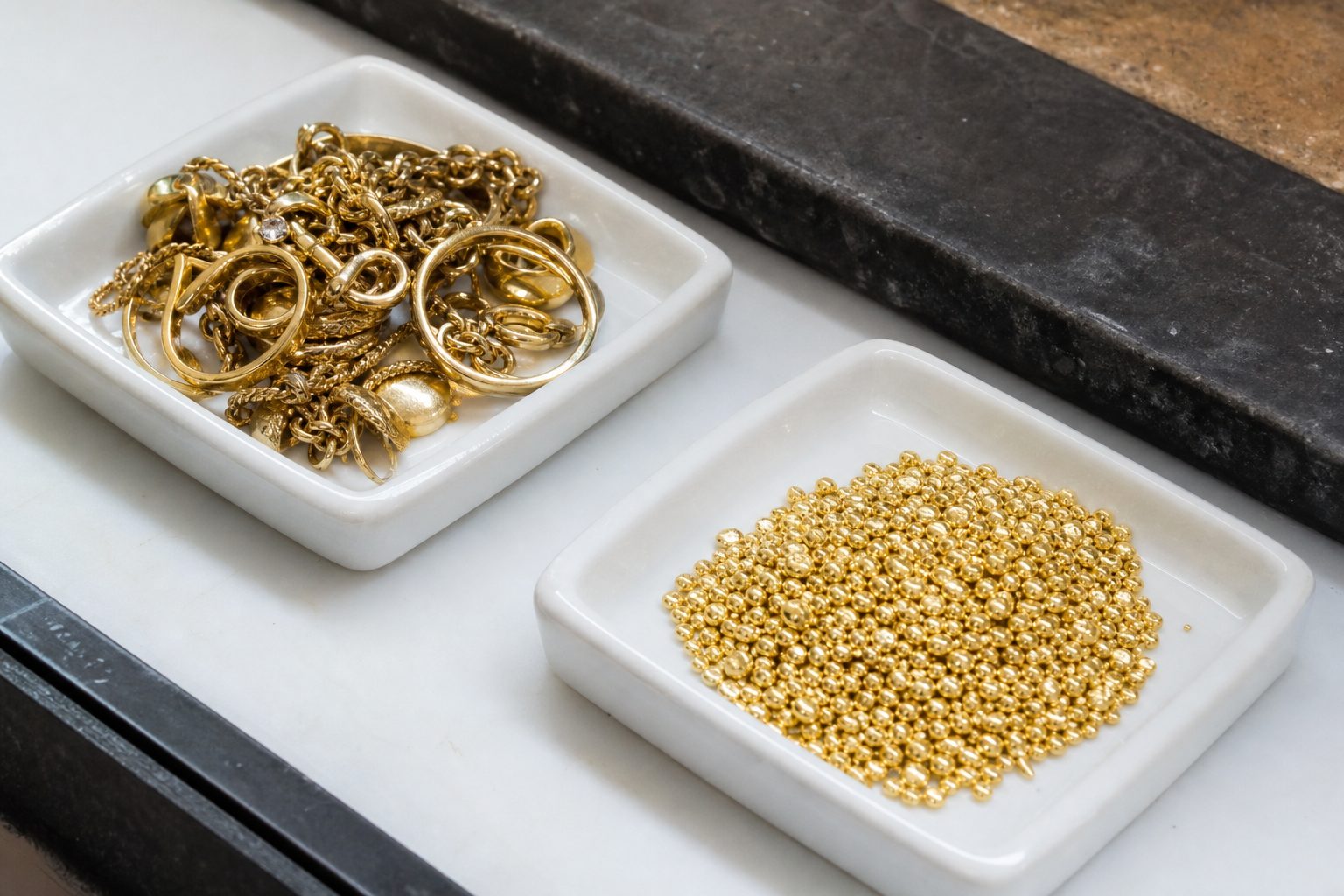
Keep reading: Should I take in a client's heirloom gold for melt, or quote new casting grain instead?
Converting a wax weight into finished metal weight by karat
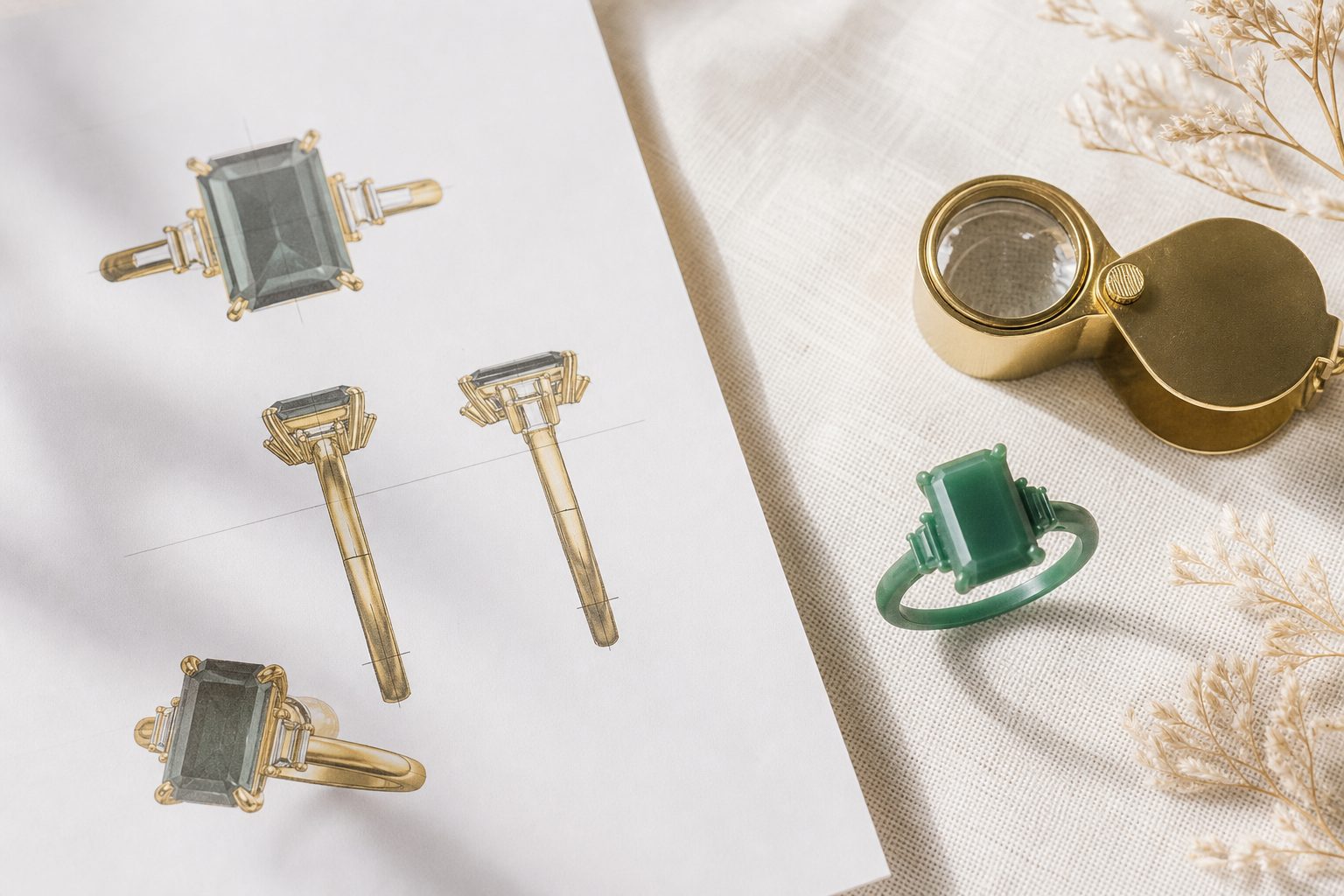
Your CAD software or your scale gives you a wax weight. Metal weight is wax weight multiplied by a specific gravity ratio for the alloy you are casting.
The ratio is the density of the metal divided by the density of the wax. Casting wax runs close to 1.0 grams per cubic centimeter, so the ratio is approximately the density of the alloy itself. Common working figures, which vary by alloy, so confirm them against your caster's sheet:
| Alloy | Approximate density (g/cc) | Metal grams per 1 g of wax |
|---|---|---|
| Sterling silver | 10.4 | 10.4 |
| 14K yellow | 13.1 | 13.1 |
| 14K white | 12.7 | 12.7 |
| 18K yellow | 15.5 | 15.5 |
| Platinum 950 | 20.1 | 20.1 |
A 1.4 gram wax in 14K yellow is roughly 18.3 grams of metal. That is the casting, not the sprue and button, and not the loss.
Add the sprue, the button and the loss
You pay for metal that never ends up in the ring. Sprue and button are recoverable as scrap, but only at your refiner's return terms. Filing dust and polishing lemel are recoverable in theory and mostly not in practice on a one ring job.
A workable convention: quote the casting weight plus a sprue allowance your caster states, then add a finishing loss allowance of five to ten percent on top for filing, sanding and polishing. If you recover scrap efficiently, that allowance becomes margin. Treat those percentages as your assumptions, and check them against a year of actual invoices before you defend them to anyone.
Building a metal surcharge window into the quote
Write the metal line so it reads as a calculation, not as a promise. Something like: 14K yellow, estimated 18.3 g finished weight at $92.00 per gram delivered, quoted at a gold spot of $2,650 per troy ounce on March 14, 2026.
Then add one sentence: if the metal is not purchased within 21 days of this quote, the metal line is recalculated at the delivered cost on the purchase date, and the balance adjusts up or down.
Two details make this palatable. First, say up or down, and mean it. If gold falls, credit her. Clients accept a variable line far more easily when it is genuinely two-sided. Second, cap the exposure. A sentence such as if the recalculated metal cost exceeds the quoted metal cost by more than 10 percent, we will contact you before proceeding tells her she will never open an invoice and find a shock.
A worked example
Assume the same ring, 18.3 grams of 14K yellow, quoted at $92.00 per gram delivered, so $1,684 of metal. Assume labor at 9 bench hours, a stone the client supplies, and finishing.
- Metal: $1,684
- Bench labor, 9 hours at $95: $855
- Casting, finishing and rhodium if applicable: $210
- Setting one center and eight melee: $180
- Quoted total: $2,929
Now assume gold moves up eight percent before she signs. The metal line becomes about $1,819, an increase of $135. The total goes to $3,064, an increase of 4.6 percent. Every one of these figures is an assumption for illustration, so substitute your own rate and your own delivered cost per gram. The point is the shape: a headline-grabbing eight percent move in gold changes her ring by under five percent, because metal is only 57 percent of this particular job. Show her that arithmetic and the conversation gets short.
Keep reading: What goes wrong when a commission has no written stage approval before the stones are set?
Choosing a quote expiration that clients accept
Too short reads as pressure. Too long is a free option on the gold market that you wrote for someone else. A rule of thumb by job type:
- Simple band or straightforward remount: 30 days. Low metal weight, low absolute exposure.
- Heavier ring, wide band, signet, platinum anything: 14 to 21 days. Metal dominates the quote, so the exposure is real.
- Multi-piece commission or a suite: 14 days on metal, 60 days on labor. Separate the two expirations. Your hourly rate is not volatile, so do not make it look like it is.
Put the expiration in words, not a day count. "Valid through April 4, 2026" is unambiguous. "Valid 21 days" invites a debate about when the clock started.
Locking metal at deposit versus at casting
| Lock at deposit | Lock at casting | |
|---|---|---|
| What you do | Buy the grain, or place the metal order with your caster, the day the deposit clears | Buy metal when the wax is approved and ready to cast |
| Cash effect | Deposit funds convert to inventory immediately | Deposit sits in the bank until casting day |
| Price risk | None after deposit | You carry the move from deposit to casting, unless you requote |
| Fits | Designs that are settled at deposit, repeat forms, bands | Long design cycles with several CAD revisions |
| Risk if the design changes | You bought metal for a weight that may change | None, weight is final when you buy |
Most independent designers should lock at deposit for anything where the form is agreed, and lock at casting for open-ended design work, with an explicit requote clause covering the gap. What you should not do is lock at neither and quietly hope.
See how BeadInvoice handles this for fine and handmade jewelry commissions
Reading your casting house price sheet line by line
Casting invoices are where quiet margin leaks. Go through your caster's current sheet and find each of these:
- Metal basis. Is metal billed at their cost plus a percentage, or at a posted daily rate? Ask which index and which time of day.
- Fabrication or handling per pennyweight. Often listed separately from the metal itself.
- Casting fee. Per piece, per tree, or by weight. This changes which jobs are worth batching.
- Minimum charges. A one ring order can trip a shop minimum that doubles the effective cost.
- Scrap return terms. What percentage of the sprue and button value do you get back, and after what settlement fee?
- Rush surcharge. Know the threshold before a client asks for a date.
- Recast policy on porosity. Who pays for metal on a failed cast, and does that change if the metal was client supplied?
Rebuild your delivered cost per gram from this sheet once a quarter. If you have not done it since gold was materially cheaper, your quoting number is stale and you are the one paying for it.
What to say when a client asks why the number changed
Lead with the structure, not with an apology. "The labor and setting on your ring have not changed. The metal line is a pass-through and it is recalculated on the day we buy, which is what your quote says. Here is the old gram price and the new one."
Then show her the two-sided nature of it. Clients react badly to a one-way ratchet and reasonably well to a market. If your policy credits her on a fall, say so, and mean it enough that you have done it once.
If she pushes back hard on a small increase, you have three moves that do not involve eating the difference: reduce the shank thickness slightly, which lowers grams; move a hollow element into the design; or offer 14K where 18K was specified, with an honest note about color and wear. All three are design conversations, which is the conversation you want to be having.
Putting it into the quote you actually send
The reason metal surprises get expensive is almost never the math. It is that the quote lived in an email, the deposit was a verbal yes, and nobody wrote down which spot price the number came from. Six weeks later there is no document to point at.
BeadInvoice is built for exactly this shape of job: you enter the metal weight and karat, the stone cost and the bench hours, and it produces a quote where each of those is its own line with its own date and its own expiration. The deposit is collected against that quote before the wax goes to the caster, so the metal you buy is metal a client has already committed to. When the window lapses, the metal line requotes and the labor line does not.
Start with one job. Rebuild your delivered cost per gram from your last three invoices, put a real expiration date on the next quote, and hold the deposit before you order grain. The market will keep moving. Your quote will stop moving with it.