mistakes to avoid
What goes wrong when a commission has no written stage approval before the stones are set?
Most commission disputes trace back to one skipped signature. A walk through the failure points from CAD render to final polish, and the approval gates that stop each one.
What goes wrong is that the piece becomes unchangeable while the client still thinks it is a draft. Once a diamond is seated and the prongs are burnished over, undoing anything means cutting metal, annealing, refinishing and often recasting. The client experiences a request as a small tweak. You experience it as most of the job again. Without a signed approval at the gate before setting, there is no shared record of what she agreed to, so the cost of the change lands on whoever is worse at arguing.
The second thing that goes wrong is quieter. In the absence of a formal gate, clients keep revising, because nothing has told them the design phase ended. Scope creep in custom jewelry is rarely one dramatic demand. It is eleven small ones across five weeks.
Approval gates fix both. They are not legal armor so much as a shared clock: at each stage, this is what we agreed, and here is what changes cost from here forward.
The five stages where a client can still change direction
Map your process to a fixed set of gates and use the same ones on every commission. A workable set:
| Gate | What is being approved | Cost to change after |
|---|---|---|
| 1. Design brief | Style, budget range, stones, metal, timeline | Nothing yet, free |
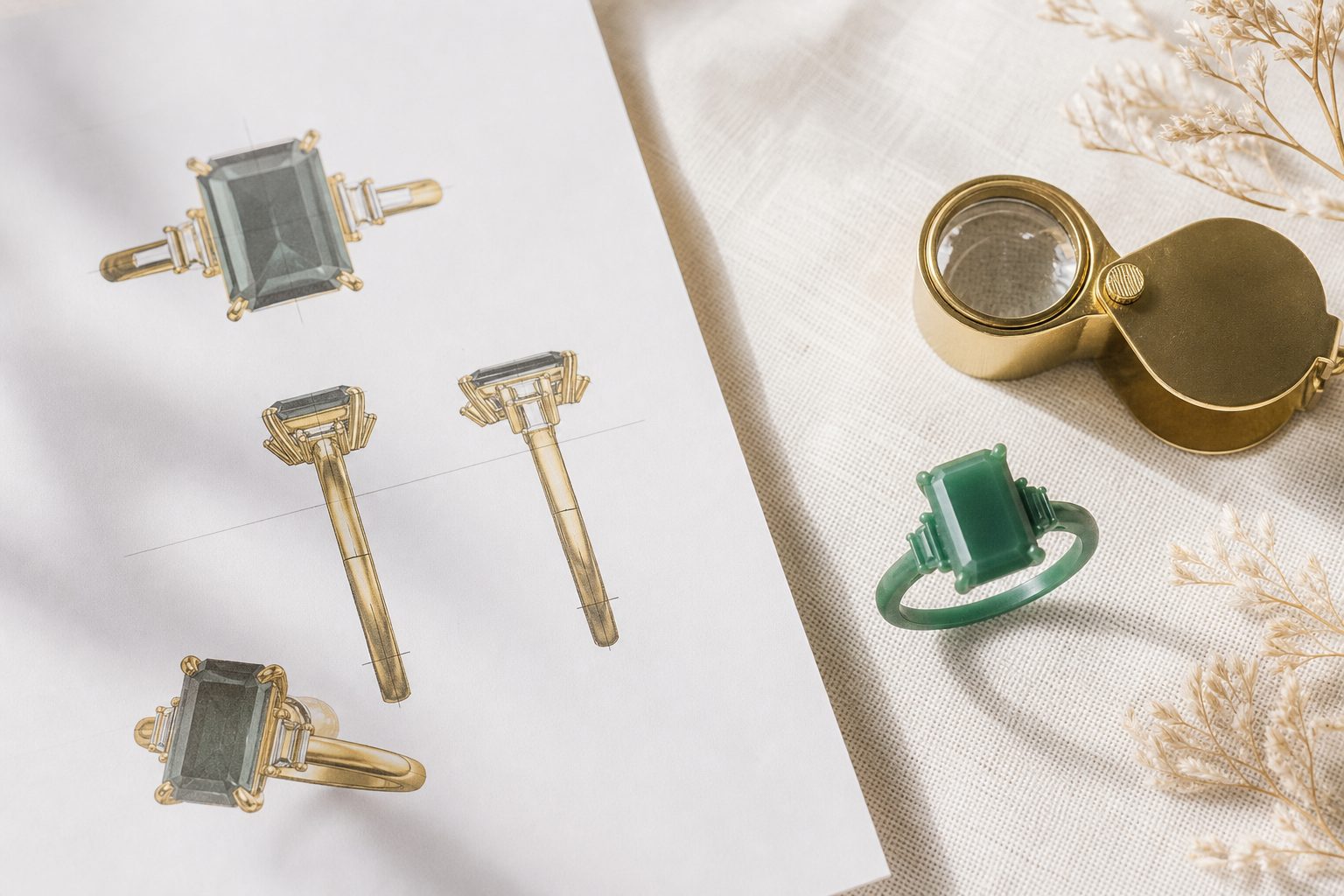
| 2. CAD render | Proportions, gallery, profile, stone layout | CAD revision fee, days |
| 3. Wax or resin fitting | Fit, finger size, physical scale, comfort | New print, days |
| 4. Casting in metal, pre-set | Metal color, surface finish, head style | Significant bench hours, possible recast |
| 5. Set and finished | Final approval and release | Stones out, refinish, real risk to stones |
Gate 4 is the one people skip and the one that matters most. It is the last moment where metal can be reworked without a stone in the way.
Keep reading: Do I need to give a client a treatment and origin disclosure on a custom diamond commission?
CAD render approval and what a render cannot show
A polished render is persuasive and slightly dishonest. It shows an idealized object under studio lighting that no physical ring will ever quite match. Clients approve renders enthusiastically and then feel a small letdown at the wax, which is when the revision requests start.
Head off the specific things a render misrepresents:
- Scale. A ring shown at 400 percent on a phone screen reads as far larger than 6.5 millimeters of actual metal. Always include a millimeter dimension callout and, better, a rendered hand shot.
- Metal color. Screens do not show the difference between 14K and 18K yellow, and rhodium-plated white gold on screen is a generic silver. Put physical samples in her hand.
- Stone appearance. Rendered stones sparkle in a way real stones do under specific light. Rendered color is essentially decorative.
- Weight and heft. Nothing on a screen conveys that a wide 18K band feels substantially heavier than she pictured.
- Finish. A render's matte is not your matte. Show a finished sample of the exact finish you intend.
State your revision policy on the render itself: two rounds of CAD revisions are included, additional rounds are billed at a stated fee. This is normal, clients accept it readily, and it converts unlimited revision into a decision.
Wax fitting, finger size and the reality gap
The wax or resin print is the first honest conversation about the object. Use it deliberately rather than as a formality.
Have her wear it. Have her wear it next to the ring she wears daily, and next to her wedding band if there will be one. Check that the profile does not gap against a curved band, check knuckle clearance, and check that she can get it off comfortably, because a ring she has to fight is a ring she stops wearing.
Size, honestly documented
Finger size is the single most common post-delivery complaint and the easiest to prevent on paper. Record on the approval: the measured size, the sizer set used, the time of day and rough temperature, whether she had been outside, and any note about swelling, arthritis or knuckle differential. Note also the band width, because a wide band sits tighter than a narrow one at the same nominal size, typically by a quarter to a half size.
Then write the resizing policy where she signs: one complimentary sizing within 60 days, and after that a stated fee, with a note that eternity bands and channel-set designs may not be resizable at all. Say that last part out loud, not just in writing.
Keep reading: How did one designer rebuild her remount business around a fifty percent deposit policy?
Approving the head, the setting style and the metal color
Gate 4 covers the decisions that look small in conversation and are expensive in metal.
- Head and prong count. Four prong versus six changes the look and the security of the stone. Swapping after casting means removing and replacing a head, and refinishing the shoulders.
- Setting style. Prong, bezel, half bezel, channel or pave are structurally different. A bezel is not a change of mind, it is a different piece.
- Metal color and plating. If white gold, decide now whether it is rhodium plated, and tell her plainly that plating wears and needs redoing every year or two depending on wear. That single sentence prevents a warranty conversation twelve months out.
- Surface finish. High polish, satin, brushed, hammered, or a mix. Some finishes cannot be applied cleanly after stones are in without risking the stones.
- Engraving. Interior engraving is straightforward before setting and awkward after. Get the exact text, spelled out, approved in writing. Names and dates get transposed constantly.
Show her the casting in daylight, on her hand, before it goes to the setter. Five minutes here saves a week later.
Why post-setting changes cost so much more
Make the arithmetic visible rather than asking her to trust that it is expensive. Consider a request to change from a four prong to a six prong head after setting, on a piece with a center stone and pave shoulders.
- Unset the center stone, carefully, without chipping a girdle.
- Cut off the existing head and clean the seat.
- Fit and solder the new head, protecting the existing pave from heat.
- Refinish and repolish the entire top of the ring.
- Reset the center stone and retighten adjacent pave.
- Final polish, clean and inspect.
Assume that runs five bench hours at $95, so $475, plus a $70 head, plus your risk on a stone that a client owns. Those figures are illustrative assumptions, so use your own rate. The identical decision made at Gate 4, before setting, is roughly one hour and a $70 part, because there is no stone to remove and no pave to protect.
Show her that comparison at Gate 4, in writing, as the reason the gate exists. It reframes the signature from a legal formality into you protecting her money.
See how BeadInvoice handles this for fine and handmade jewelry commissions
Documenting approvals in writing without killing the mood
The fear is real: nobody wants to hand a contract to a woman who is emotional about her mother's diamond. So do not make the approval feel like a contract. Make it feel like a summary.
Three rules keep it warm:
- Keep it to one screen. A short list of what was decided, a photo or render, a date, and a single confirm action. Not a page of terms.
- Send it immediately after the conversation, while she is still pleased. An approval that arrives three days later reads as a demand.
- Use her words back to her. "Slightly lower profile so it sits flat against your band" is warmer and more precise than "profile height revised per client."
Frame it out loud as a shared record: "I am going to send you a summary of what we settled today so we both have it, and so nothing gets lost between now and casting." Nobody has ever objected to that sentence.
What each approval should contain
Date, stage name, an image of the current state, the specific decisions made, what happens next, the expected date for the next stage, and a note of what changes cost from this point. Then her confirmation, timestamped.
Handling the client who approved and then changed her mind
She will. It is a ring she will wear for forty years, and second thoughts are reasonable. Your job is to make the change a choice with a price rather than a fight about who said what.
Work the conversation in this order. Acknowledge first, genuinely, because she is not being difficult, she is being careful. Then pull up the approval and walk through it without accusation: here is where we are, here is what we agreed at this gate. Then present options with numbers attached, usually three: leave as is, a small adjustment at a stated cost, or the full change at a stated cost and a new date. Let her choose.
Decide in advance where your goodwill line sits, and be consistent. A reasonable posture: anything that is your error is fixed free and fast, no discussion. Anything that is a change of mind is quoted, at a rate that reflects the real work. Anything that risks a client's stone is refused unless she accepts the risk in writing.
Building gates into how you actually work
Approval gates fail for one reason, which is that they live in your head and not in the workflow. When the summary is an email you mean to send tonight, half of them never go, and the ones that do get buried in a thread nobody can find in March.
BeadInvoice puts the gates in the job itself. Each commission carries its stages, and each stage holds the images, the decisions and the client's approval with a timestamp, sitting next to the quote and the deposit that started the work. When she asks in week six what was decided in week two, you open one record instead of searching your inbox.
Pick your gates, write the five summaries once, and run your next commission through them exactly. The first job feels like extra admin. The second one is the reason you stop losing bench hours to conversations you already had.