case study
How did one designer rebuild her remount business around a fifty percent deposit policy?
A studio taking heirloom remounts moved from handshake starts to a signed deposit at intake. What changed in cash flow, in cancellations, and in the kind of client who said yes.
She stopped starting work on trust. That is the whole change, and it took one season to make.
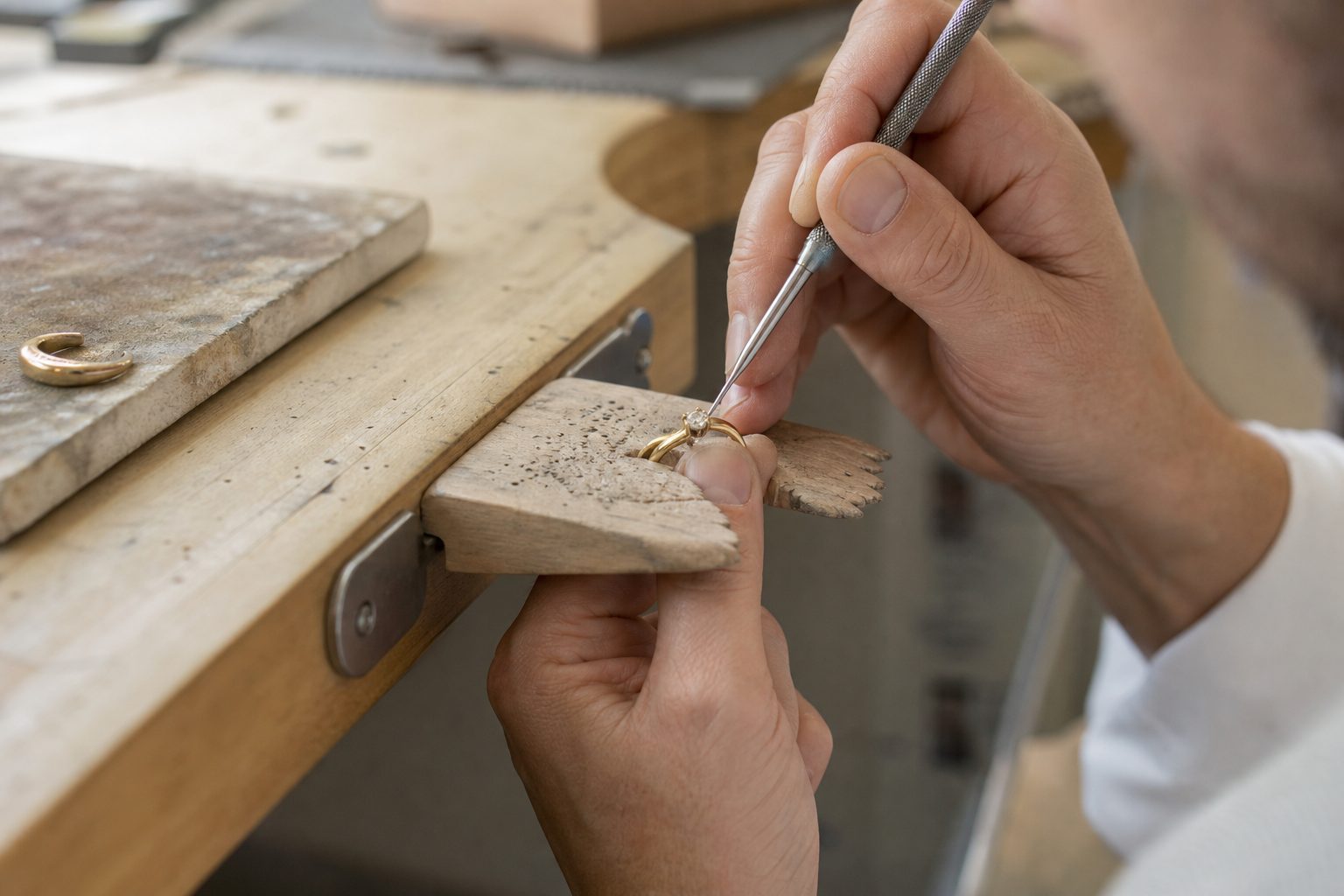
The studio described here takes heirloom remounts: grandmother's ring, a parcel of loose stones from a divorce, three mismatched pieces melted into one. Two benches, one owner, roughly forty commissions a year. The details below are a composite drawn from how remount studios of that size actually run, and every dollar figure is an illustrative assumption stated as such, so you can swap your own numbers into the same arithmetic. The structure is what transfers.
Before the change, deposits were casual: sometimes a couple hundred dollars, sometimes nothing, always a conversation she disliked having. After, it was fifty percent at intake, signed, no exceptions, collected before the CAD file was opened. Cash flow stopped swinging. Cancellations did not disappear, but they stopped costing her anything.
The old process and where the money got stuck
The old sequence looked reasonable on paper. Consultation, sketch, verbal price range, order the casting grain and the side stones, wax or CAD, client approval, bench work, call for pickup, take payment in full.
Money got stuck in two places, and both were before pickup.
The first was material outlay. On a remount she is often buying metal even though the client brought gold in, because scrap from a worn shank rarely yields enough clean alloy for a new setting, and refining credit takes weeks to land. So she fronted casting grain, melee, and sometimes a replacement center. On a typical job in this composite, call it $900 of material bought before a dollar came in.
The second was time. Four weeks of turnaround with a client who has gone quiet, then a pickup that slides to "after the holidays," then a card that declines. Meanwhile the next three consultations are also being paid for out of her own float.
The pattern that finally forced the issue: she was carrying six open jobs at once, each with several hundred dollars of her money inside it, and she was declining new work not because the bench was full but because the checking account was.
Keep reading: Is the shift toward lab grown center stones changing what I should quote for bench labor?
Setting the deposit against actual material outlay
Fifty percent is a clean number to say out loud. But she did not pick it because it sounded right. She picked it by checking that fifty percent of a typical quote covered everything she spends before the client sees the finished piece.
Here is that check, with assumed figures for one mid range remount.
| Line | Assumed amount | Paid before delivery? |
|---|---|---|
| Casting grain, 14K white, 9 dwt | $430 | Yes |
| Melee, 0.40 ctw side stones | $260 | Yes |
| Casting house fee and finishing supplies | $110 | Yes |
| CAD and design time, 3 hours at $85 | $255 | Her time, unrecoverable |
| Bench time, 6 hours at $85 | $510 | Her time, unrecoverable |
| Setting and finishing, 3 hours at $85 | $255 | Her time, unrecoverable |
| Quote total | $1,820 |
Hard cash out the door before delivery: $800. Fifty percent of the quote is $910. The deposit covers the material with $110 to spare, and it covers the design hours she burns before the client ever approves anything.
Run this on your own last five jobs. If your material fraction is higher, because you buy center stones rather than reset the client's, fifty percent may not be enough and sixty is the honest number. If you mostly reset client stones into simple settings, forty may clear it. The deposit is not a negotiating position. It is the size of the hole you dig before you get paid.
Rewriting the intake conversation around the deposit
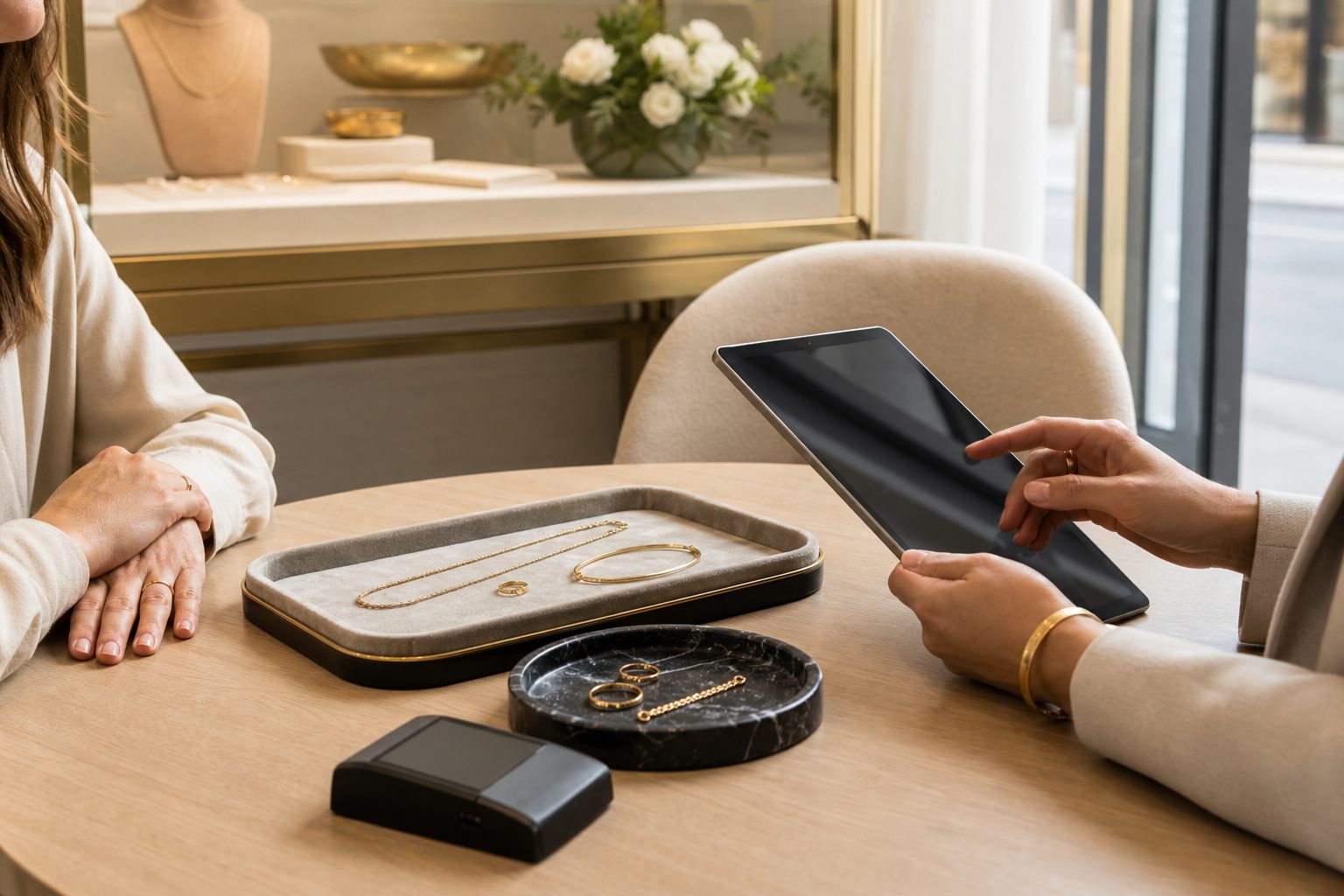
The old script ended with "I'll put together a quote and send it over." The new one ends with the deposit taken in the room.
The reordering matters more than the wording. She moved the deposit ask from the end of the conversation to the middle, right after the design direction was agreed and before the exact price was finalized, by quoting a range and taking the deposit against it.
The sequence she uses now
- Look at the piece together. Weigh it, photograph it, note the stones and any damage.
- Talk design. Sketch two directions on paper while she is sitting there.
- State the range: "This lands between $1,600 and $2,000 depending on the final metal weight."
- Explain the deposit in terms of what it buys: "I take half to order your metal and side stones. That gets your job on the bench calendar."
- Sign the intake form and run the card before she leaves.
- Send the exact quote within two days, with the deposit already credited on it.
Step four is the one to memorize. Clients do not resist a deposit. They resist a deposit that sounds like distrust. Tied to a purchase order for her own metal, it reads as procurement, which is what it is.
Keep reading: What should I check before I accept a client's stone across my bench for a remount?
Cancellations before and after the change
The count of cancellations barely moved. Two or three a year, before and after. What changed was who they were and what they cost.
Before, a cancellation arrived at pickup. Piece finished, $800 of material converted into a ring sized for a specific finger with someone else's grandmother's stone in it, and no buyer. She could recover the melee and the metal at scrap or refining value, which on the numbers above is perhaps $300 of the $800, and none of the twelve hours.
After, cancellations arrive early, usually within a week, before the casting is ordered. She keeps the deposit under the signed terms, releases the stones back, and the job is closed. Same number of cancellations, roughly zero net loss.
There is a second effect worth naming. The clients who used to cancel late were often the ones who never fully committed at the consultation. Asking for money in the room surfaces that in ten minutes instead of ten weeks.
Handling clients who ask to pay at pickup
They still ask. Three answers cover almost every version of it.
- "Can I just pay when it's done?" "I order your metal and stones this week, so I take half now. The balance is due at pickup and I'll text you the moment it's ready."
- "I've bought from you before." "I know, and that's why I'd rather not change the terms for you and then have to explain it differently to the next person. It's the same for everyone."
- "That's a lot right now." This one is real, and it deserves a real answer. Offer to split the deposit into two payments two weeks apart, and simply start the job when the second clears. The bench calendar is the lever, not the price.
What she will not do is start work on a promise. The one carve out she allows is a repair under about $200, where her material exposure is a few grams of solder and an hour, and the risk genuinely is not worth the friction.
See how BeadInvoice handles this for fine and handmade jewelry commissions
What the deposit covers if the client walks away
The terms have to say this explicitly, or the deposit is just money you are holding and may have to give back.
Her language covers four things: the design time already performed, materials ordered specifically for the commission, the bench slot reserved, and the fact that a custom piece has no resale market at anything near its build cost. That last point is the substantive reason a custom deposit is treated differently from a deposit on stock merchandise, and it is worth stating in the document rather than assuming it is understood.
She also defines the client's side. If the piece is not delivered by a stated outside date and the delay is hers, the deposit is refundable in full. That reciprocity is what makes the clause read as fair instead of one sided, and it is the sentence clients most often mention when they sign without argument.
The paperwork that made the policy enforceable
A verbal deposit policy is a preference. A signed one is a term of sale. The intake document she uses now fits on one page and carries:
- Client name, contact, and the date.
- A description of every item received, with weights and a photograph reference, including damage noted at intake.
- The design direction and the agreed price range, with the basis for the final number.
- The deposit amount, the date paid, and the method.
- The nonrefundable terms and the delivery date that triggers refundability.
- Approval stages: CAD approval, and a wax or render sign off, each dated.
- Signature lines for both parties.
The stage approvals do quiet work. A client who signed off on the CAD cannot credibly reopen the head style after the setting is finished, and a documented approval date is what turns "I never liked that" into a change order with its own price.
Where to start if you are still taking work on a handshake
Pull your last five commissions. Add up what you spent before delivery on each, divide by the quoted total, and you have your deposit percentage. Write the terms once. Then take the deposit in the room, every time, starting with the next consultation on your calendar.
The mechanics are easier when the quote and the deposit are the same document. BeadInvoice quotes the metal weight, the stone cost and the bench hours on one page, holds the deposit against that quote before the casting is ordered, and carries the CAD and wax approvals through as dated stages, so the file itself is the record if a job ever goes sideways.