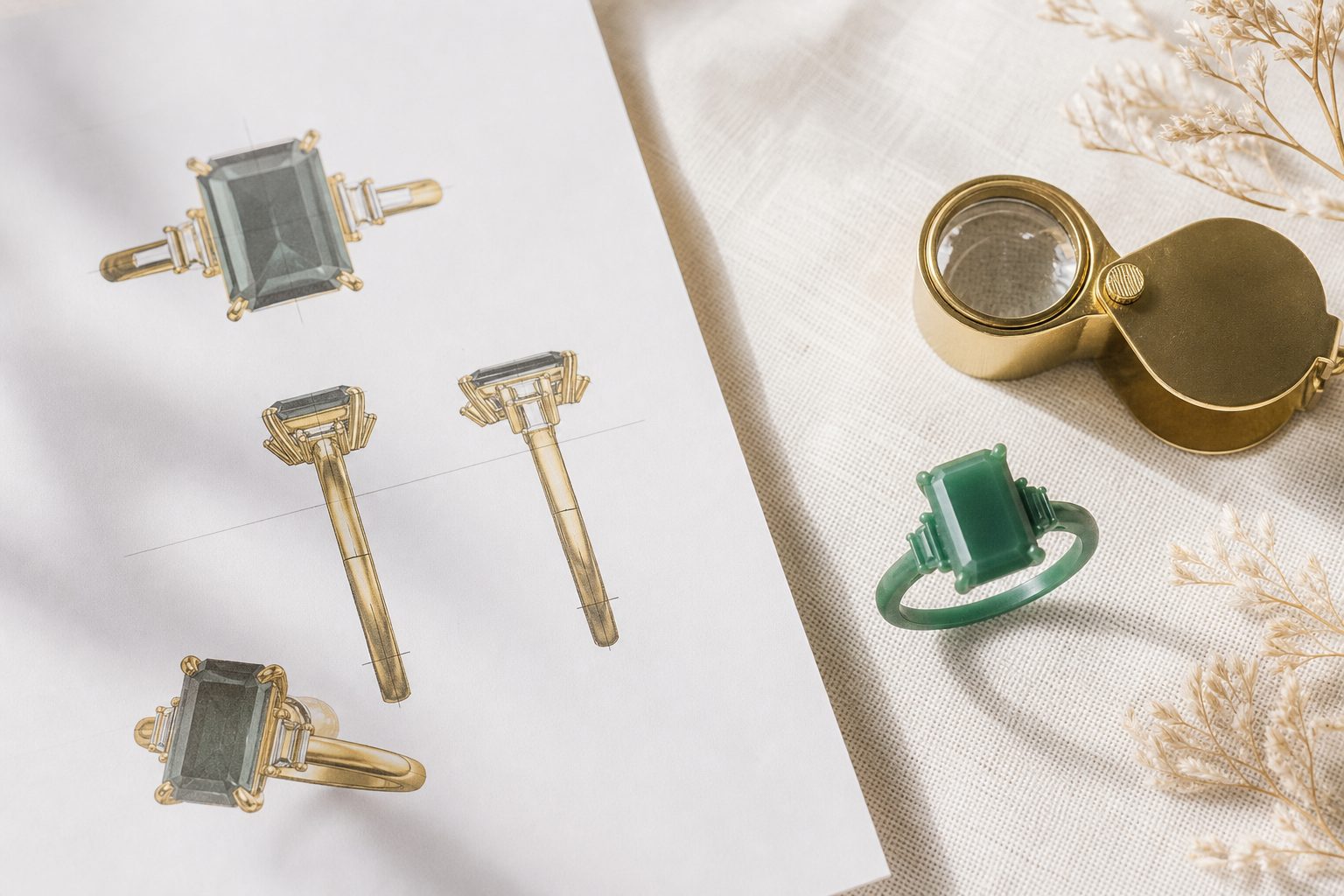
comparison
Should I take in a client's heirloom gold for melt, or quote new casting grain instead?
Reusing a grandmother's ring feels generous and sells the story, but old metal carries porosity, unknown alloys and liability. A side by side look at cost, risk and finish quality.
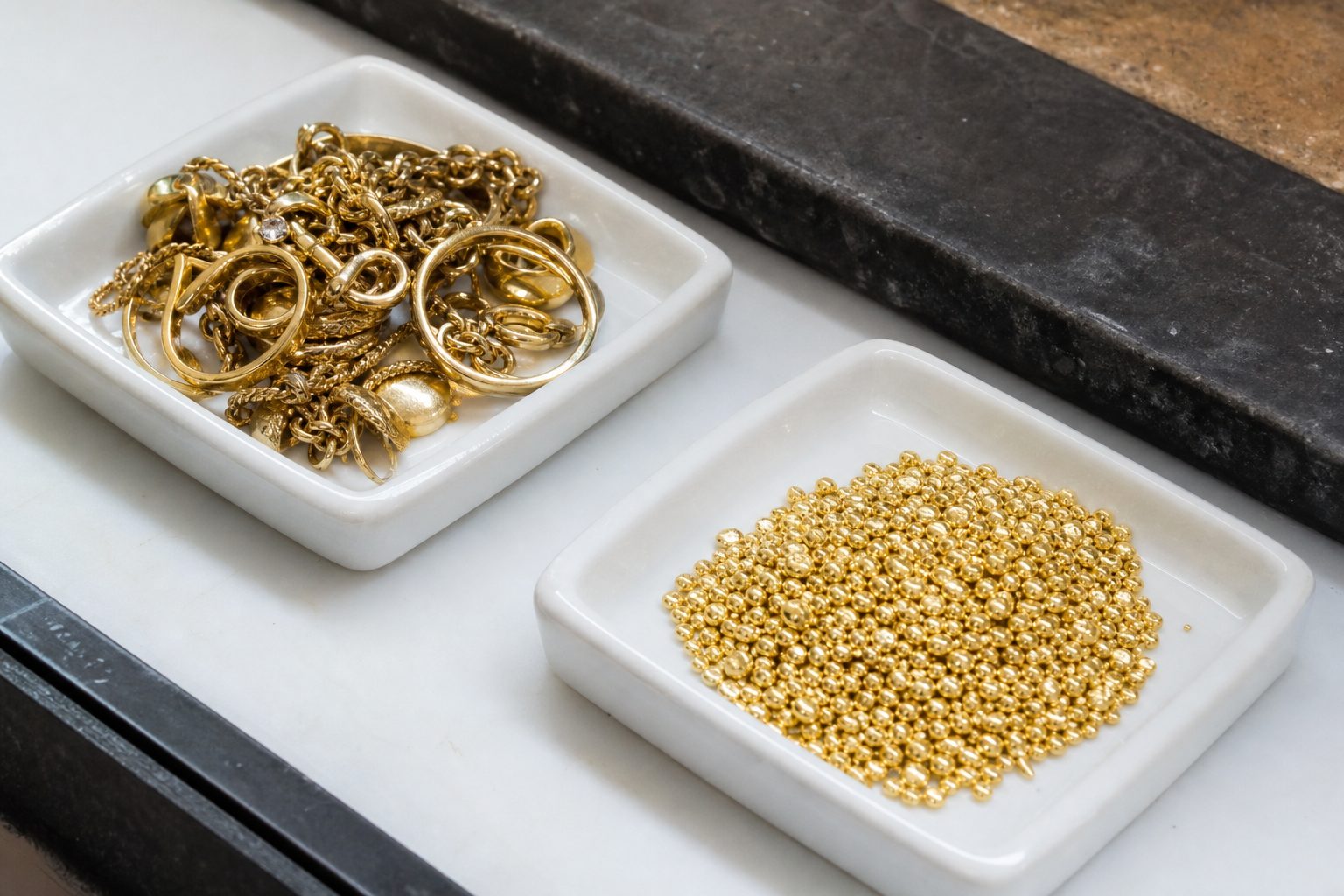
For most commissions, quote new casting grain and treat the client's heirloom gold as a separate transaction: you buy it or you refine it, and the credit shows up as a line on her invoice. You do not put it in the crucible for her ring. That one policy removes almost every way this goes badly, and it still lets her feel that grandmother's gold paid for the piece.
The exception is narrow. If the metal is clean, single-karat, unsoldered, unplated and you can verify it, direct reuse is technically workable. That describes very little of what comes across a counter.
What follows is why old alloy misbehaves, how to test what you have been handed, the actual dollar comparison, and the sentence that keeps you out of a fight over something irreplaceable.
What actually happens to old alloy in the crucible
Karat gold is gold plus a base metal recipe. In 14K yellow, roughly 42 percent of the mass is copper, silver and zinc. Those metals do not survive melting the way gold does.
Zinc is the problem child. It boils well below the temperature at which you pour gold, so every melt drives some of it off as vapor. Copper oxidizes. The result is that a remelted alloy is not the alloy you started with: it is slightly richer in gold, poorer in zinc, and its flow characteristics have changed. Zinc is what makes casting grain fill thin sections cleanly, so as it leaves, the metal gets sluggish and incomplete fills become more likely.
Refiners and grain suppliers handle this by adding fresh master alloy to bring the recipe back to spec. On a bench melt of a client's ring, nobody is doing that, because nobody knows the starting recipe.
Keep reading: What goes wrong when a commission has no written stage approval before the stones are set?
Porosity, solder contamination and why castings fail
Three failure modes account for most bad results from reused metal.
- Gas porosity. Molten gold dissolves gases and releases them as it solidifies, leaving pinholes. Metal that has been melted repeatedly, or metal carrying oxides from a previous life, is far more prone to it. Porosity often does not appear until you are polishing, which means the labor is already spent.
- Solder contamination. Almost every old ring has been sized, and sizing solder is a lower karat, lower melting alloy, sometimes carrying cadmium in older work. It disperses through the melt and creates soft, discolored, unpredictable zones.
- Foreign inclusions. Steel spring bars, white metal findings, plating layers, laser weld deposits and old epoxy all end up in the pot if you did not remove them, and steel in gold is a genuine ruin.
The commercial issue is not that these failures happen. It is who pays. On a failed cast in new grain, your caster's recast policy usually covers it. On client-supplied metal, almost no casting house will warrant the result, and you have just consumed metal that cannot be replaced.
Testing and karat verification before you accept metal
Do not accept metal on a family story. Do this at intake, with the client watching, and write down what you find.
- Look for marks. 14K, 585, 18K, 750, 417, a maker's mark. Note that a mark is a claim, not a fact, and imported and antique goods are frequently off.
- Magnet test. Fast, free, catches steel components and many plated base metal pieces.
- Acid test on a touchstone, or an electronic tester if you have one. Test each piece separately. A "lot" of gold is often three different karats.
- Inspect for solder joints and repairs. Loupe the shank, the shoulders and any sizing seam. Note plating, rhodium or laser welds.
- Weigh each piece and record it, on a scale she can see, and give her a written receipt with piece by piece descriptions and weights before anything leaves the counter.
That receipt matters more than the testing. Weight disputes over inherited jewelry are common and unwinnable without a signed intake record.
Keep reading: Do I need to give a client a treatment and origin disclosure on a custom diamond commission?
Cost math: melt credit versus buying fresh grain
Run the numbers rather than arguing about sentiment. Take a client bringing 22 grams of assorted marked 14K, and a ring needing 18 grams of finished 14K yellow. All figures below are illustrative assumptions, so substitute your own refiner terms and your own delivered grain cost.
Path A, direct reuse at the bench. Assume 22 grams in, roughly 10 percent lost to burnout, skimming and the reduced yield after removing solder-heavy sections, so about 19.8 grams of usable metal. It just covers the casting, with nothing spare and no second chance if the cast fails. Your cost is your labor to prepare and melt it, call it an hour, plus elevated risk. Metal purchase: $0.
Path B, buy new grain, credit her the scrap. Assume delivered 14K grain at $92 per gram, so 18 grams plus a sprue and finishing allowance, call it 21 grams, for $1,932. On the credit side, assume you pay her a scrap rate that reflects 14K fine content at a settlement percentage your refiner actually pays, and assume that comes to $58 per gram on 22 grams, which is $1,276. Net metal cost to the job: $656.
| Direct reuse | New grain plus scrap credit | |
|---|---|---|
| Metal outlay | None | $1,932, offset by $1,276 credit |
| Casting warranty | Typically void | Normal recast policy applies |
| Failure consequence | Irreplaceable material lost | Recast, few days lost |
| Extra bench labor | Prep, sort, melt, more finishing | None |
| Client story | "Her gold is in the ring" | "Her gold paid for the ring" |
Path B looks more expensive on the metal line and is usually cheaper in total, because the failure cost in Path A is not a percentage, it is the whole job plus a relationship.
The one number that decides it
Ask yourself what a failed cast costs you here. If the answer includes the phrase "and I could never replace it," you are not in a cost comparison. You are in a risk decision, and the answer is new grain.
Refining as the middle path and how refiner terms work
Refining is the honest middle. You send her metal to a refiner, they assay it, and they pay or credit you on the actual fine gold content. The physical atoms do not come back, but the value does, verified.
Read your refiner's terms for these specifics before you promise anyone a number:
- Settlement percentage. What share of the assayed fine value you receive. It differs for karat scrap, for filings and for polishing sweeps.
- Assay and treatment charges. Often a flat lot fee plus a per-ounce charge.
- Lot minimum. Below it you get a worse rate, which is why small quantities are usually better handled as an outright purchase.
- Settlement timing. Days from receipt to payment, and whether the gold price is fixed on receipt or on your instruction.
- Metal account option. Some refiners will credit you in grams rather than dollars, which lets you take payment as grain and neatly sidesteps the whole spot price question.
That last one is worth a phone call. Being paid in metal turns a client's scrap directly into casting stock without exposing either of you to a price move in between.
See how BeadInvoice handles this for fine and handmade jewelry commissions
Liability language for irreplaceable heirloom material
Whatever path you take, the intake document should be explicit. Keep it short and human, and have her sign it.
Cover four things. First, an itemized description and weight of every piece received, dated. Second, a plain statement that melting is irreversible and that the item as it exists will not survive the process. Third, an acknowledgment that client-supplied metal is not covered by casting warranty and that if a cast fails, additional metal will be purchased at her cost. Fourth, what happens to stones removed from the piece: returned, reset, or held, and where they are stored in the meantime.
Add a photograph of every piece at intake, taken next to the scale reading. It takes ninety seconds and it ends any later disagreement about what came in.
When to say no and how to offer the stone-only alternative
Decline the melt outright when any of these is true: you cannot verify the karat, the piece shows multiple solder repairs or plating, the total weight leaves no margin over the required casting weight, the piece has genuine antique or maker value, or the client's emotional attachment is to this object rather than to its material.
That last one deserves attention. When someone says "I want her ring in my ring," she often does not mean the atoms. She means continuity. Offer alternatives that deliver it more reliably:
- Reset the original stones in a new piece and return the empty mounting to her, intact.
- Use a small identifiable element, a bezel, a piece of the shank, an engraved section, incorporated into a new design.
- Buy the scrap outright, credit it against the commission, and put the payment on the invoice where she can see the number.
- Restore the original and build the new piece separately, so she ends with two.
Every one of these is a better story than a pinhole in a shank that used to be her grandmother's.
Making the credit visible on the quote
Most of the friction here is documentary rather than metallurgical. The intake weights live on a paper slip, the scrap credit gets agreed verbally, and by the time the balance is due, nobody remembers what was promised.
BeadInvoice handles that by keeping the metal, the stones and the bench hours as separate lines on one commission record, with a credit line for client-supplied material sitting alongside them. She sees the grain you bought, she sees what her gold was worth, and she sees the deposit she paid before the wax went out. The whole conversation stops being a negotiation and becomes a statement.
Set your policy this week, write the intake sheet once, and use it on the next tangle of old chain that lands on your bench. You will refuse fewer commissions and lose far less sleep.